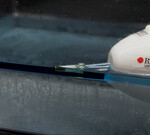
Award-winning technology to improve office building comfort
A device designed to improve indoor environmental quality, developed at the University of Sydney’s Indoor Environmental Quality (IEQ) Lab, was declared the People’s Choice winner of the ‘Weapons of Mass Creation’ innovation award at the Green Cities 2015 conference in Melbourne last week.
The technology, known as SAMBA, is a highly sophisticated unit that is designed to measure air temperature and speed, humidity, light, sound and air pollutants - the key factors shown to have the greatest impact on an office worker’s health, comfort and productivity. PhD student Tom Parkinson developed the idea with his brother Alex under the leadership of Professor Richard de Dear, an expert in indoor climate and air quality.

According to Professor de Dear, SAMBA is designed to act as “a building’s eyes, ears, nose and skin”. Multiple units would ideally be placed in an office to capture the indoor environmental factors in different locations, which then gets fed back in real time to a central server for analysis.
“Clearly the continuing transition towards an energy-efficient, low-carbon economy will have an impact on comfort levels within built environments,” said Professor de Dear, who noted that over 90% of NSW office blocks have air conditioning. “But what impact this will have, on the people for whom buildings exist, is what we are interested in measuring.”
Professor de Dear said SAMBA will “help to make sense of the science by giving companies the information or evidence to understand how efficiently and effectively their building is operating for the comfort of its people”. He noted that the technology has been “produced at a relatively low cost and will have high returns for companies and their employees”.
SAMBA is currently shortlisted for the Property Council of Australia’s 2015 Innovation & Excellence Awards, to be announced in Sydney on 1 May.
Floating wind turbine design could access cheaper energy
Modelling showed the design could survive a one-in-100-year storm and be moored in water up to...
WA wind farm to generate power for 100,000 homes
The 179 MW Narrogin Wind Farm is expected to generate enough clean energy to meet about 3% of the...
Ampd launches next-gen battery storage for heavy industries
Following the success of its Enertainer ESS, the company's NextGen product range is targeted...